
Do you often find yourself battling with productivity slumps and mood swings throughout the month? What if I told you that harnessing the power of your menstrual cycle could unlock a whole new level of productivity and well-being? Enter cycle syncing – a practice gaining traction for its potential to optimise productivity by aligning tasks with the four stages of the menstrual cycle.
The stages of the menstrual cycle
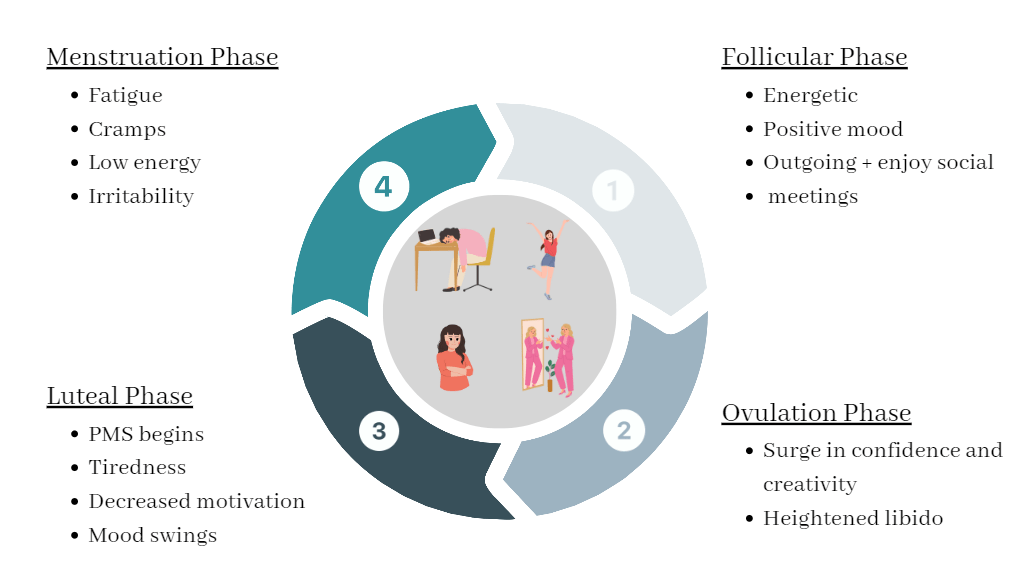
The menstrual cycle comprises four phases: menstrual, follicular, ovulation, and luteal.
This monthly cycle can influence productivity due to hormonal fluctuations impacting energy levels, mood, and cognitive function (see below). These hormonal fluctuations can impact cognitive functions such as memory, concentration, and decision-making, potentially affecting productivity. Understanding these patterns can help us manage our energy levels, workload, and self-care practices more effectively throughout the menstrual cycle.

Source: http://yubad.org/women-s-hormone-chart/
Menstrual Phase
This phase, lasting from the first day of bleeding to the last, typically extends for 3 to 7 days.
Hormonal Changes
During menstruation, hormone levels are generally low, with a slight increase in oestrogen and a modest decrease in progesterone.
Effects on Productivity
Energy, focus, and productivity levels tend to be lowest during menstruation.
Strategies for Working in this Phase
- Consider scaling back on work tasks to allow for rest and recuperation.
- Prioritise getting sleep and rest.
- Reduce social commitments to conserve energy.
- Grant yourself grace if tasks are completed at a slower pace.
Follicular Phase
The second phase, known as the follicular phase, starts as menstrual bleeding ends. During this phase, the uterus begins preparations for potential pregnancy. It can span from 11 to 27 days, with an average duration of 16 days.
Hormonal Fluctuations
In the follicular phase, there’s a notable surge in progesterone and oestrogen levels. Testosterone remains relatively stable, though it may increase toward the phase’s end.
Impact on Productivity
Elevated energy levels, attributed to rising oestrogen, characterise this phase. Productivity may be enhanced, and motivation to excel heightened.
Tips for Productivity
- Utilise this phase to initiate proactive and creative tasks.
- Engage in challenging and intricate projects, as cognitive abilities are optimised.
- Seize the opportunity to tackle complex endeavours with vigour.
Ovulation Phase
Occurring in the middle of the menstrual cycle, the ovulation phase marks the release of an egg. While typically lasting only 24 hours, heightened oestrogen and testosterone levels can make this phase noticeable for 3 to 4 days. Fluctuations may also be felt a few days before and after ovulation.
Hormonal Changes
During ovulation, both oestrogen and testosterone reach their peaks, while progesterone decreases initially before gradually rising toward the phase’s end.
Impact on Productivity
The peak of testosterone provides an outward-focused energy, while heightened oestrogen fosters feelings of vitality and proactiveness.
Tips for Productivity
- Schedule important meetings and challenging discussions during this time.
- Utilise the extroverted energy for collaborative work in group settings.
- Seize the opportunity to pursue ambitious projects and goals.
Luteal Phase
The luteal phase follows ovulation when the egg remains unfertilised, and the uterus prepares for menstruation. Typically lasting from 12 to 14 days, this phase is associated with hormonal fluctuations and premenstrual symptoms.
Hormonal Shifts
During the luteal phase, both oestrogen and progesterone levels rise, with progesterone peaking before decreasing sharply at the phase’s end. This hormonal interplay may lead to a slower mental pace compared to earlier phases.
Impact on Productivity
Productivity levels tend to decrease during this phase, aligning with the natural winding-down process. The onset of premenstrual symptoms (PMS) may prompt feelings of introspection and a desire for comfort.
Tips for Productivity
- Embrace the reflective and intuitive nature of this phase.
- Allow yourself time for self-care and relaxation.
- Incorporate gentle activities into your routine to support well-being and ease any discomfort.
How to work in this phase:
- Prioritise self-care.
- Lighten your workload if possible.
- Try to limit face time at work — focus instead on solo tasks.
- Use this time for simpler work tasks that require less active brain power, such as editing your work or catching up on admin.
How does this relate to productivity?
During the menstrual phase, energy levels may dip, and mood swings are common. However, the follicular phase sees a surge in energy and motivation, making it an ideal time for tackling challenging tasks and initiating new projects. Ovulation brings heightened energy and confidence, while the luteal phase may bring a more introspective mood, perfect for reflection and planning.
Research suggests that aligning tasks with the natural rhythm of our bodies can lead to increased productivity and overall well-being [1]. By recognising which phase of the menstrual cycle we’re in and adapting our schedules accordingly, we can leverage our hormonal fluctuations to our advantage.
So, how can we learn to sync our activities with our menstrual cycle? Start by tracking your cycle and noting how you feel during each phase. Period tracker apps:
- Flo
- Clue
- Ovia
- Glow
- My Cycle
Experiment with adjusting your workload based on your energy levels and motivation. During high-energy phases like the follicular and ovulation phases, prioritise demanding tasks and creative endeavours. Save lighter tasks and self-care activities for the menstrual and luteal phases when energy levels may be lower.
Additionally, implementing strategies to support overall menstrual health, such as nourishing foods, regular exercise, and stress management techniques, can help maintain hormonal balance and enhance productivity throughout the cycle.
In conclusion, cycle syncing offers a holistic approach to productivity that honours the natural rhythms of the body. By embracing the fluctuations of the menstrual cycle and learning to work with them rather than against them, we can unlock our fullest potential and achieve our goals with greater ease and efficiency.
References: [1] Alexandra Mysoor, 2018: How women can use monthly periods as a productive tool https://www.forbes.com/sites/alexandramysoor/2018/05/10/how-women-can-use-monthly-periods-as-a-productivity-tool/

Leave a comment